
Running a Sex Offender Check in East Hartford
East Hartford has no county sheriff, county government, or separate town sex offender database. Connecticut abolished county government in 1960, so the authoritative public path is the Connecticut Sex Offender Registry. The Department of Emergency Services and Public Protection, or DESPP, maintains it through the Division of State Police Sex Offender Registry Unit. Search by a known name when checking a specific person. For place-based safety planning, use East Hartford, the correct ZIP code, a street address, and any radius or map controls offered by the portal.
The second channel is the National Sex Offender Public Website, or NSOPW, maintained by the U.S. Department of Justice. It is most useful when a person has lived outside Connecticut or when a safety check crosses state lines. East Hartford Police handles local verification and enforcement activity, but its call reports are not a public roster. Start with the state system for the best Connecticut detail, then use NSOPW to widen the geographic scope.
East Hartford Registry Search Controls
A place search can reveal results that a name-only query misses. Enter East Hartford as the city, then test the relevant ZIP or address path. The research identifies 06108 and 06118 as East Hartford areas, but the address's actual ZIP should control. A radius search can help when the point of concern sits near a town line. Map and list views answer different questions: the map shows location patterns, while the list makes it easier to compare names and open each complete profile.
Aliases and spelling variants also matter. A blank result does not prove that no registrant is linked to the area. The public file can differ from law enforcement's complete registration file when a court restricts dissemination under Connecticut law. Search broad first, narrow only after reviewing the initial set, and confirm any apparent match by photograph, physical details, address, offense information, and agency status.
Searching the Connecticut Sex Offender Registry
The official interface begins with a conditions-of-use notice. Read it before entering the search. It explains the public-safety purpose of registry data and warns against misuse. These four steps keep an East Hartford sex offender search tied to the official record rather than to a copied or stale listing.
- Open the Connecticut registry, read its disclaimer, and accept the stated conditions of use.
- Search by last and first name, or choose a geographic path using East Hartford, ZIP, address, or radius.
- Compare the result list with known identifiers and test aliases or spelling changes when needed.
- Open the full profile and review its address, offense, status, reporting agency, and registration term.
The fields are optional paths, not proof by themselves. Portal-dependent controls may change, so use only the choices shown on the live form.
| Field Label | Type | Required | Options or Format Notes |
|---|---|---|---|
| Last Name | Text | No | Try known spelling variants and aliases. |
| First Name | Text | No | Use to narrow a surname result. |
| City | Text or dropdown | No | Enter East Hartford for town results. |
| ZIP | Text | No | Use the actual address ZIP; local areas include 06108 and 06118. |
| Address | Text | No | Starts the geographic proximity path where offered. |
| Radius | Dropdown | No | Select only a distance shown on the current portal. |
| Map or List | View control | No | Switches between geographic and list presentations. |
| Email Alerts | Signup control | No | Use a monitored location and confirm signup if offered. |
Note: Search controls can change, so record the live choices instead of assuming that an older radius or alert option still exists.
East Hartford Registry Versus NSOPW
The Connecticut registry and NSOPW overlap, but they serve different search needs. DESPP is the direct source for the state's public registration data, local status, and agency contact. NSOPW sends a query across participating state, territorial, and tribal public registries. Use the Connecticut source first for a current East Hartford address question. Add the national source when a person moved, uses an out-of-state address, or may have a record from another jurisdiction.
The Department of Justice source for the national search also provides a clear visual reference for that wider layer.
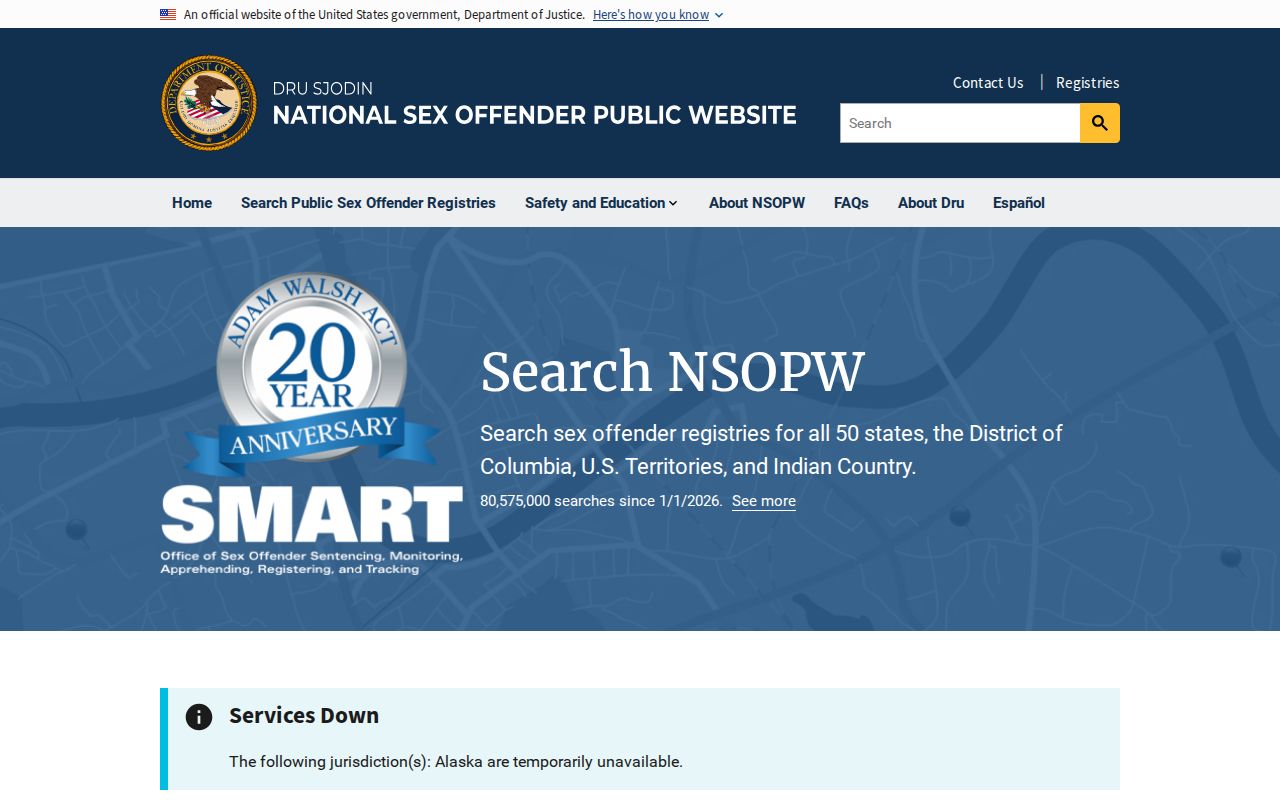
This captured interface shows why NSOPW should supplement, not replace, the detailed Connecticut profile and its reporting-agency information. Neither source guarantees that no unlisted risk exists. Public search coverage is set by each jurisdiction's law and disclosure rules.
What a Registry Profile Shows
An official Connecticut profile gives several identifiers that should be read together. No single field is enough to identify a person reliably. The public inventory can include a photograph, physical description, date-of-birth or age display, scars or tattoos, address data, the qualifying offense, and current registration status. Some vehicle, school, or work details may appear when state law makes them public. Victim identity and treatment information are not public under Connecticut General Statutes §54-258.
| Name & Aliases | Legal name plus alternate names or spellings included in the public record. |
|---|---|
| Photo & Physical Description | Current photograph when supplied, sex, race, height, weight, hair, eyes, and identifying marks. |
| Registered Address | Residential address or the level of geographic detail Connecticut law permits for public display. |
| Offense & Statute | Qualifying offense description, statute, and available conviction or court information. |
| Category / Term | Registration start and end information or a lifetime indicator, rather than a simple public tier label. |
| Registration Status | Compliance or other status, relevant dates, and the agency contact responsible for the entry. |
Public granularity has limits. A profile may omit fields that remain in the law-enforcement file, and a court may restrict dissemination in a qualifying case. Read the profile as the public portion of a state record, not as a complete case file.
East Hartford Profiles Lack Simple Tiers
Connecticut does not present every public registrant as Tier I, Tier II, or Tier III. The framework is based on the qualifying offense, statutory category, another jurisdiction's duty, or a court finding. That distinction matters in East Hartford because a reader cannot infer risk or duration from a tier badge that the public profile does not use. Look instead for the named offense, controlling statute, term, status, and any court restriction.
The public registry may also be narrower than the registration data available to law enforcement. Connecticut General Statutes §§54-251 through 54-254 set the main category rules, while §54-255 permits restricted dissemination in defined cases. A missing public profile can have several causes and should not prompt a guess about someone's legal status.
Registration Requirements and Levels in Connecticut
The duration table uses Connecticut's statutory categories rather than invented risk levels. Under the general rules, a nonviolent sexual offense or criminal offense against a minor carries a ten-year term, while a sexually violent offense generally requires lifetime registration. Out-of-state duties and felonies committed for a sexual purpose depend on their triggering classification or court order. Registrants provide required identity, address, photograph or fingerprint, and conviction details. They must also report specified changes.
| Statutory Category | General Duration | Public Qualification Note |
|---|---|---|
| Nonviolent sexual offense or offense against a minor, §54-251 | 10 years under the general rule | A court restriction may apply in a defined case. |
| Sexually violent offense, §54-252 | Life | Statutory verification duties continue. |
| Out-of-state registrant, §54-253 | Tied to the offense and other-jurisdiction duty | Connecticut registration begins within the statutory deadline after residence or status changes. |
| Felony committed for sexual purpose, §54-254 | As ordered or prescribed by law | The court finding or order controls. |
Address changes must be reported through the official process, and cross-state moves can create a duty in more than one jurisdiction. Short statutory reporting deadlines can also apply to email or Internet identifiers. The Sex Offender Registry Unit, not the East Hartford Town Clerk, corrects the registry record.
When East Hartford Registry Data Looks Wrong
Do not confront the listed person or household when an address seems stale. First, reopen the official profile and verify that the city, status, and reporting agency match the result you viewed. Check the Connecticut registry again by exact address and by name. Then use NSOPW if another state may be involved. A copied search-engine result or old screenshot is not a sound basis for action.
For a non-emergency East Hartford concern, call EHPD at (860) 528-4401 and state the precise issue. DESPP's Sex Offender Registry Unit can be reached at (860) 685-8060 for state-record questions and corrections. Call 911 only for an emergency. EHPD's monthly category called “SEX OFFENDER REGISTRY-CID” reflects police activity, not the number of people registered in town.
Note: A police call category counts activity, so it must never be presented as East Hartford's current registrant population.
East Hartford Address Alerts and Maps
Location tools support a different kind of review than a name search. If the Connecticut portal offers email alerts, enter the address or monitored location, select the available area, and complete the confirmation step. The subscription works only as well as its saved location and the public data supplied to the service. Return to the live profile when an alert arrives rather than relying on the notice alone.
Map boundaries can also mislead near East Hartford's edge. An address-radius view may cross into Hartford, Manchester, Glastonbury, or another nearby municipality even though the city filter does not. That is useful for a neighborhood safety plan. It is not evidence that each mapped person lives in East Hartford. Compare the result's displayed municipality and address with the map pin before drawing a conclusion.
Lawful Use and Community Notification
Connecticut publishes registry data for public safety and community awareness. Use it to understand an official profile, plan family safety, monitor a neighborhood, or report a concrete concern through official channels. The portal does not authorize surveillance, threats, public shaming, or private enforcement. It also does not promise that every person who may pose a risk appears in a public search.
Connecticut General Statutes §54-258 governs public registry disclosure and protects victim and treatment information. Its statutory misuse rule makes it a crime to use registry information to injure, harass, or commit a criminal act against a registrant or that person's family. Civil liability may also follow. Send suspected noncompliance to EHPD or SORU, then let the responsible agency verify the facts.
Registry Misuse Is a Crime: Under Connecticut General Statutes §54-258, using registry information to injure, harass, or commit a crime against a registrant or family member is prohibited and may also create civil liability.