
How to Check East Hartford Criminal History
Start an East Hartford criminal history check by deciding what fact you need. The East Hartford Police weekly reports show recent adult arrests. The Connecticut Judicial Branch separates pending and disposed criminal cases. The Connecticut Department of Correction reports current state custody. For a formal statewide product, use the State Police Bureau of Identification. No Hartford County sheriff, jail, criminal clerk, or district attorney fills these roles because Connecticut has no county government.
Gather the full name, date of birth when known, incident date, and any police incident or court docket number. Spellings matter. An EHPD incident number identifies the police event, while a Judicial Branch docket number identifies the case. Search both pending and disposed court tools before concluding that no case exists.
- Check the EHPD log or request the local incident report.
- Search both pending and disposed Connecticut criminal dockets.
- Compare name, birth year, court location, and case number.
- Check CT DOC separately if present custody matters.
- Order an SPBI product when an official statewide record is needed.
No East Hartford County Records Office
“Hartford County” remains a geographic label, but it does not describe a working county justice system. Connecticut abolished county government in 1960. An East Hartford criminal record therefore moves from the town police department to state-run prosecutors, Superior Court, correction, probation, and the central state police repository. Asking a county clerk or sheriff for it sends the request to an office that does not perform that function.
The practical split is simple. EHPD answers for its police reports and local arrest logs. The Judicial Branch answers for public court files. DESPP answers for statewide criminal-history products. CT DOC answers for custody, and the Board of Pardons and Paroles handles pardons and parole decisions.
The town clerk is another common wrong turn. That office keeps local civic records, but it is not the clerk of a criminal court. East Hartford also has no municipal criminal court. Charges from town arrests ordinarily proceed to Connecticut Superior Court in Hartford, primarily Geographical Area No. 14 and the Hartford Judicial District at 101 Lafayette Street. Serious matters may move within that state court structure without ever becoming a county case.
This division affects requests for certified copies. EHPD can certify or release only the police material it holds, subject to Connecticut disclosure rules. A Hartford criminal clerk handles permitted copies from the court file. SPBI issues its own repository product. State correction staff maintain custody data. Sending the same request to all four offices creates delay and may return four different answers because each office owns a different record.
Official Connecticut Background Checks
The State Police Bureau of Identification is Connecticut's central repository. Its public options include a $36 name and date-of-birth search that reports whether a record exists and a $75 Connecticut conviction-history search that supplies the public conviction record if one exists. A fingerprint-based Connecticut conviction search is also $75, plus the capture charge. These products are not substitutes for the town police file or the full court case.
Current ordering begins through CCHRS pre-enrollment. The service code controls the product and fee, so read the checkout description before paying. East Hartford residents may schedule fingerprint capture through EHPD. SPBI in Middletown also offers appointment-based capture.
The SPBI information page is shown in the official record-system view below.
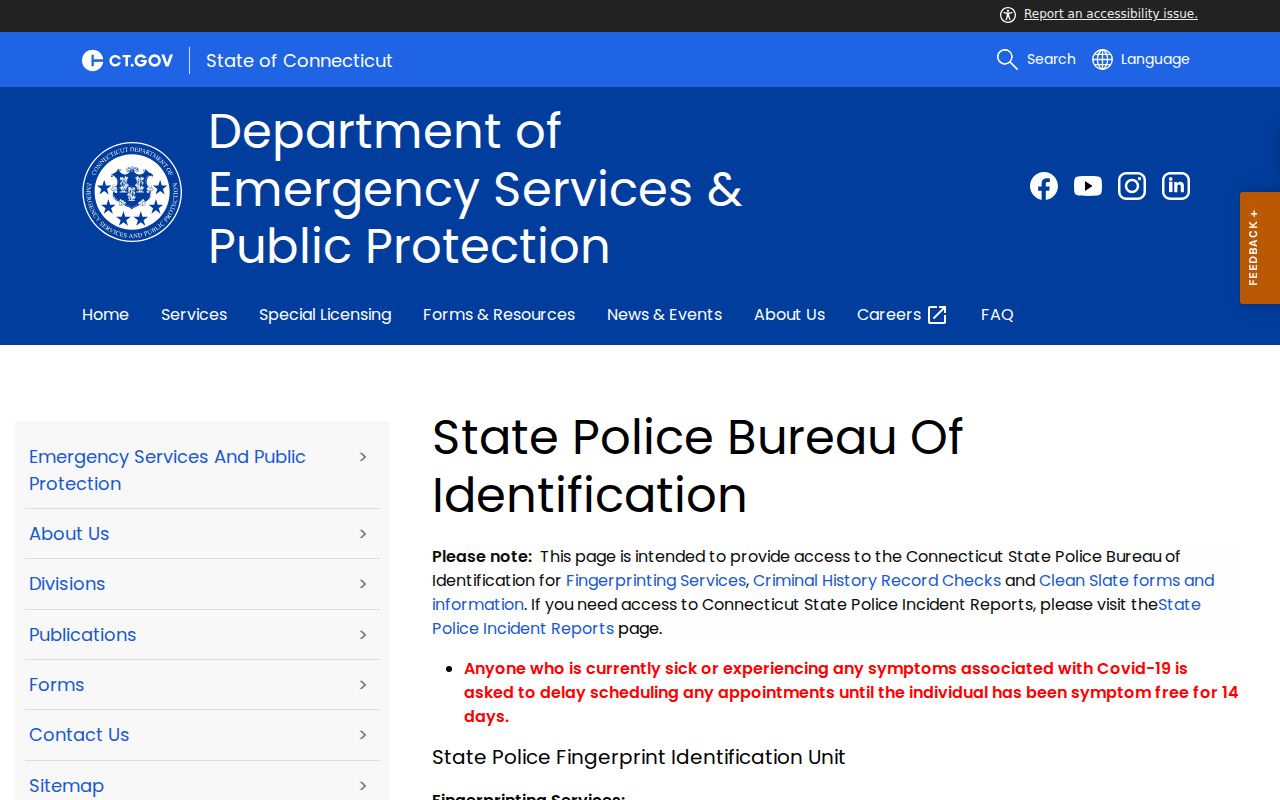
This state source is where current forms, fee guidance, and Clean Slate correction material should be confirmed.
| Official product | Published fee | What it returns |
|---|---|---|
| Existence search | $36 | Whether a Connecticut record exists |
| Conviction history | $75 | Public Connecticut conviction history |
| Fingerprint conviction search | $75 plus capture | Fingerprint-supported state result |
| SPBI fingerprint capture | $15 | Print capture by appointment |
East Hartford Records Follow Three Tracks
An EHPD report, a Hartford court docket, and an SPBI rap sheet are distinct records. Police write the first account and log the arrest. Prosecutors decide what charges to file. Superior Court then creates a docket with pleas, events, disposition, and sentence. Reported outcomes later return to SPBI and connect to the fingerprint-supported arrest cycle.
Timing and legal limits can make the tracks disagree. A recent arrest may not yet appear as a filed case. A dismissed charge may be erased from public court access. Older reporting can be incomplete, and the public SPBI conviction product is narrower than the police file. Compare the source that created each fact.
The CCHRS public workflow provides the electronic pre-enrollment screen pictured here.
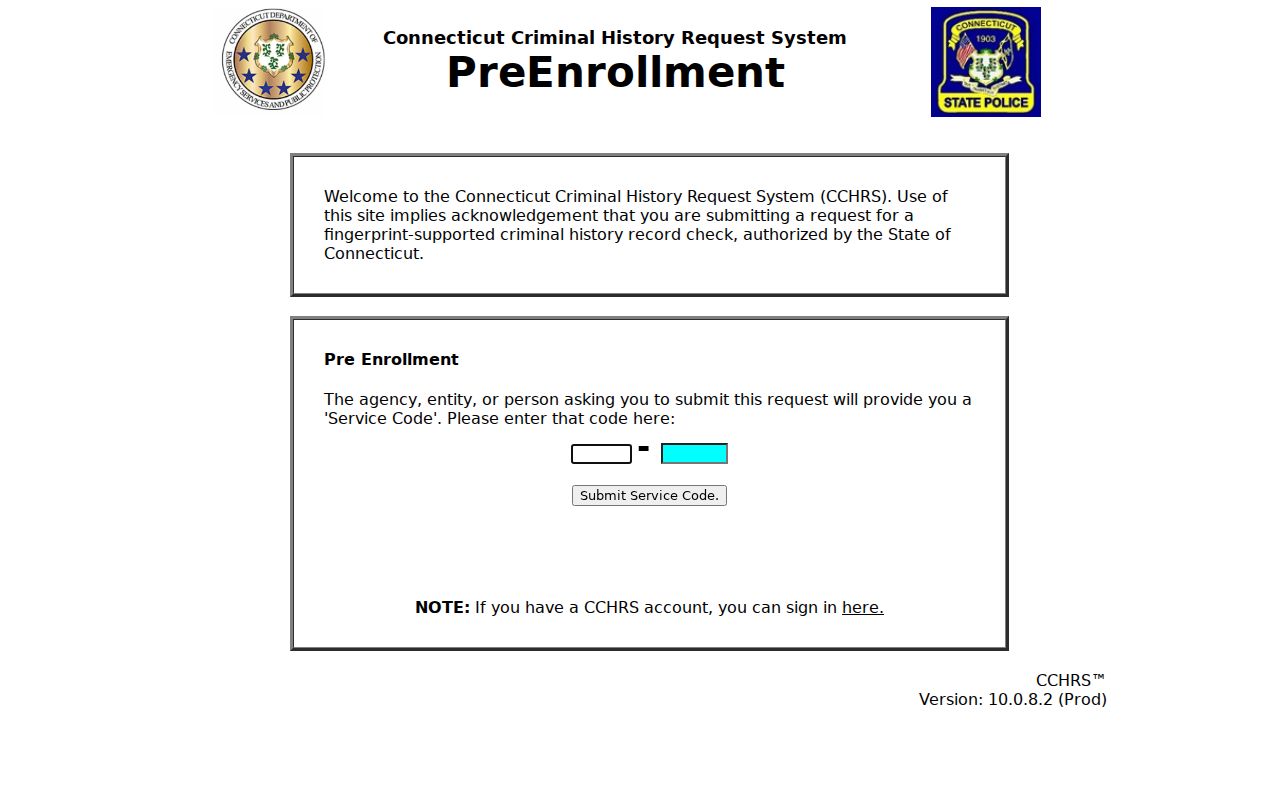
The selected service code determines which official record product is ordered.
Types of East Hartford Criminal Records
East Hartford criminal records differ by creator and purpose. A police report describes an investigated event. An arrest log gives a limited public summary. A docket tracks a prosecution, while a state criminal-history record links reported arrest cycles with qualifying outcomes. Custody, warrants, probation, parole, and registry information live in still other systems.
Use the narrowest official source that answers the question. The town police department is best for its incident file. The court is best for filed charges and disposition. State systems are best for formal history, custody, supervision, and registry status.
- Police and arrest records: EHPD incident files and weekly adult arrest reports.
- Court records: pending, disposed, and daily Hartford criminal dockets.
- Criminal-history records: SPBI repository products ordered through CCHRS.
- Custody records: CT DOC search and Connecticut VINE status notices.
- Supervision and registry records: state probation, parole, and registry systems.
East Hartford Police Report Access
The EHPD Records counter at 31 School Street is the direct route to a local report. Call (860) 528-4401 or visit Monday from 10:00 a.m. to 4:00 p.m. and Tuesday through Friday from 9:30 a.m. to 4:00 p.m. Bring the case number when possible. Staff can also work from the incident date and time. Copies cost $0.50 per page.
A clear written request should give requester contact details, incident number, date, time, location, exact record sought, party status, inspection or copy preference, and desired format. Name crash material, 911 audio, or body-worn camera footage specifically. Connecticut FOI exemptions can require redaction or withholding of protected details.
East Hartford Police Records
31 School Street
East Hartford, CT 06108
(860) 528-4401
Monday 10:00-4:00; Tuesday-Friday 9:30-4:00
Superior Court GA14/JD
101 Lafayette Street
Hartford, CT 06106
Public dockets and permitted clerk copies
What an East Hartford Criminal Record Shows
The fields depend on the record. Police material can include an incident number, arrest date, alleged offenses, location, and court date. A court file adds a docket number, statutory charge, plea, events, outcome, and sentence. A rap sheet organizes fingerprint-supported arrest cycles and reported dispositions. Read status terms carefully: an arrest or pending charge does not establish guilt.
| Name & Identifiers | Name, birth information, agency numbers, and docket identifiers. |
|---|---|
| Arrest / Booking Data | Incident number, arrest date, agency, alleged offense, and release or court date. |
| Charges & Statutes | Filed offense title, statute citation, count, and case status. |
| Disposition | Conviction, dismissal, nolle, acquittal, or another recorded outcome. |
| Sentence | Custody, suspended time, fine, probation, or other court order. |
| Custody / Supervision | Current CT DOC placement or state probation and parole status when public. |
East Hartford Custody Is State Run
East Hartford has no local long-term jail. A person remanded after court enters the unified Connecticut correctional system. Search the CT DOC Inmate Search by DOC number or by name and date of birth. Hartford Correctional Center is the nearby high-security pretrial facility, but a person may move after classification, court action, release, or transfer.
Connecticut VINE adds custody status and notification tools. It does not replace the police report or court file. A blank DOC result may mean release, transfer outside the current search scope, a spelling mismatch, or that custody never occurred. Check the Hartford docket to follow the case itself.
Public Access Laws for East Hartford Records
The Connecticut Freedom of Information Act starts from public access, but it does not make every line of every East Hartford criminal record open. Agencies may redact protected victim details, witness information, juvenile material, sealed data, and information whose release would harm a live investigation. Court rules and criminal-history dissemination laws govern other systems.
Key Statutes:
CGS §§1-200 through 1-259 - sets Connecticut's public-record framework and exemptions.
CGS §1-215 - governs access to arrest information while allowing protected details to be withheld.
CGS §54-142a - provides erasure after specified non-conviction outcomes.
CGS §54-142t - addresses Clean Slate automated erasure and review.
East Hartford Crime Counts Need Context
The EHPD 2024 annual report supplies a three-year view. Aggravated assault moved from 43 in 2022 to 28 in 2023 and 22 in 2024. Robbery moved from 33 to 22 to 16. Burglary fell from 90 to 60, then rose to 63. These are reported offense categories, not convictions.
Calls for service are broader still. January 2026 had 3,362 calls, compared with 3,615 in January 2025. A call may concern suspicious activity, a person in crisis, a protective-order issue, or another service event. Do not turn a workload count into an arrest or crime count.
Arson and sexual assault show the same need for care. The annual table lists arson at 5 in 2022, 9 in 2023, and 1 in 2024. Sexual assault moved from 39 to 29 to 21 across those years. Each figure describes reports grouped under the department's table labels. It does not say how many people were arrested, how many counts prosecutors filed, or how many cases ended in conviction. One incident can produce several calls, several alleged offenses, one arrest, or no arrest at all.
Use local statistics to understand scale and trend, then use an individual record system for a specific event. The weekly arrest report answers whether EHPD published a recent adult arrest entry. A police report adds incident detail. The Hartford docket shows the prosecution, and an SPBI product answers its own statewide history question. Keeping those measures apart prevents a crime table from being mistaken for a name-search tool.
Erased, Sealed, and Restricted Records
“Erasure” is Connecticut's statutory term. Under CGS §54-142a, specified dismissals, not-guilty findings, and nolles can be erased. Clean Slate adds automatic erasure for eligible matters, while an Absolute Pardon can erase qualifying conviction history. Juvenile and youthful-offender records follow separate access limits.
An erased case may disappear from the public docket and ordinary history products. That absence is not proof that an earlier police event never occurred, and private copies may lag behind the official change. SPBI provides forms and a review path when eligible data remains. The Board of Pardons and Paroles explains the separate Absolute Pardon process.
East Hartford Records Technology Timeline
EHPD's history gives the local record system unusual depth. The department developed an early photograph and fingerprint identification bureau, adopted police radios in 1935, and later moved into computerized report writing, records management, and dispatch. The current Public Safety Complex opened in September 2004. Those changes affect how an old East Hartford criminal record may be indexed and retrieved.
The department history also shows why older records cannot always be searched like current ones. A modern query may depend on standardized names, electronic identifiers, and linked systems that did not exist when a paper file was created. Give records staff a date range and event details when researching an older incident.
The record path also changed as Connecticut centralized court, identification, and correction functions. A current EHPD arrest can produce a town incident number, fingerprint-supported state entry, Hartford docket number, and CT DOC identifier. Older material may lack one or more of those links. Searchers should not assume that a blank modern portal means the source file never existed. Records staff may need an approximate date, location, event type, or former name to find a paper or legacy index entry.
The Connecticut Board of Pardons and Paroles maintains the official pardon and parole entry pictured below.
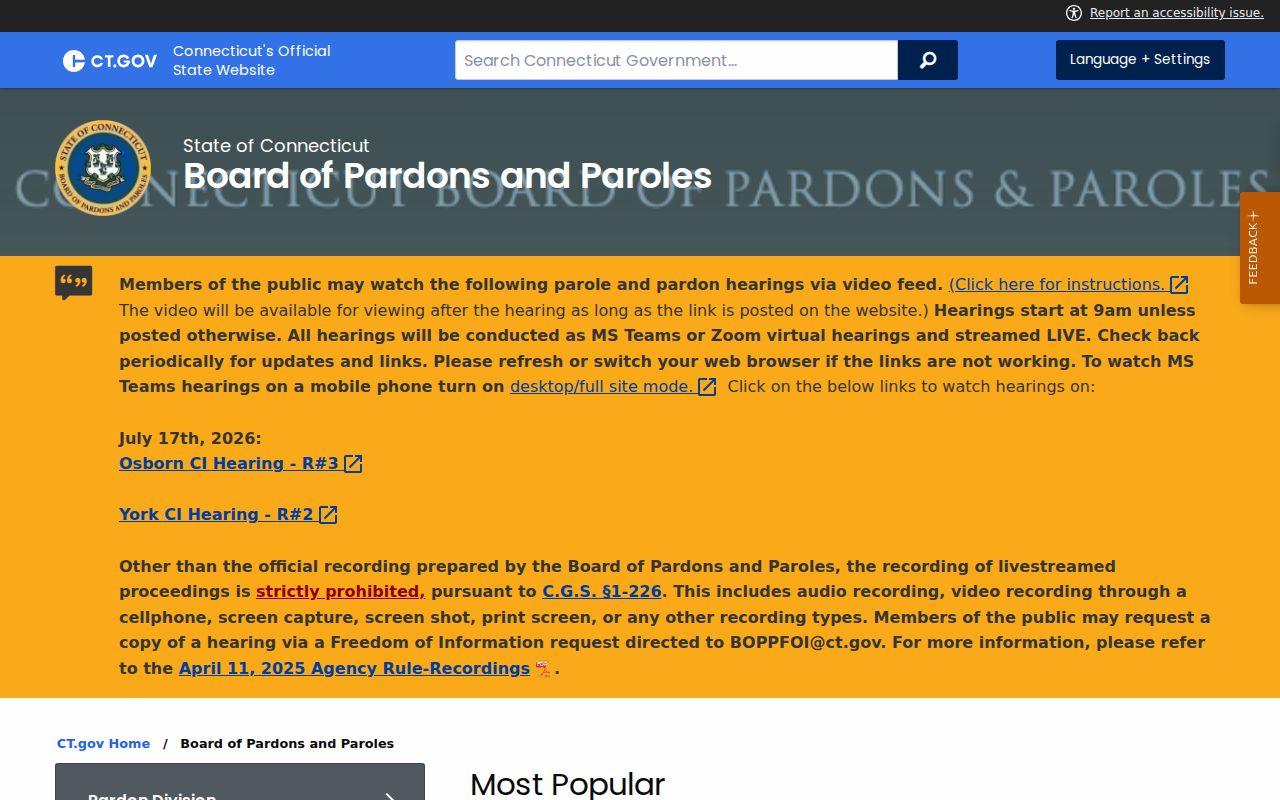
That office's pardon materials explain the separate route for an Absolute Pardon.
Criminal Records in East Hartford
East Hartford is the sole municipality in this assignment, so no neighboring Hartford County towns are added as false city guides. Local criminal-record work starts with EHPD for police material, then moves to Hartford Superior Court and the appropriate state system. The town-specific page gives more detail on records-counter hours, report fields, arrest logs, and the route from town policing to state court.
East Hartford Criminal History
2020 Census: 51,045 · EHPD records and Hartford Superior Court routing
East Hartford Federal Record Layer
Federal records sit outside the town and state chain. The U.S. District Court for the District of Connecticut creates federal case files, and PACER provides federal docket access. The FBI Identity History Summary is a subject-only fingerprint record review. The Federal Bureau of Prisons locator covers federal custody.
A state search will not necessarily reveal a federal case, and a federal search will not replace EHPD, Hartford Superior Court, or SPBI. Use the jurisdiction that created the record. That distinction is vital in a town next to Hartford, where state and federal offices are physically close but legally separate.
The District of Connecticut court site is the official federal starting point shown here.
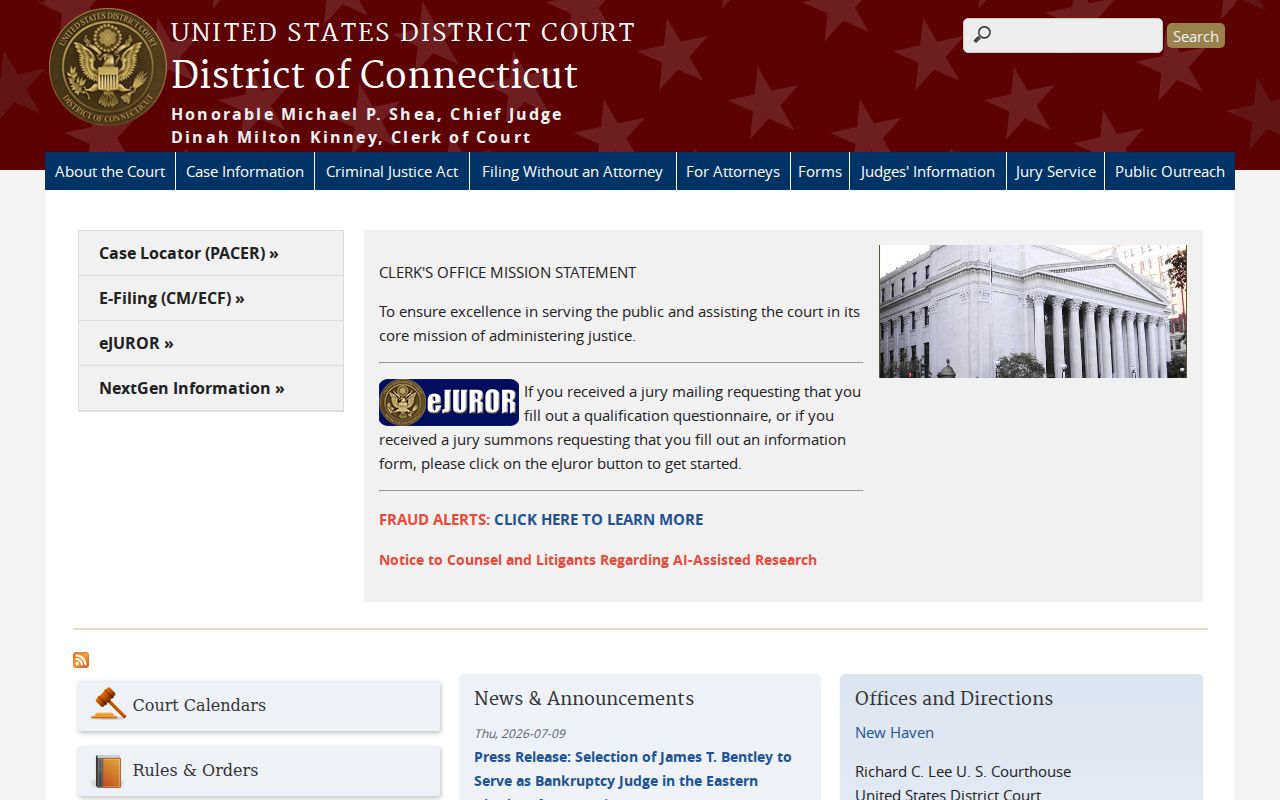
Federal docket details then move through the court or PACER, not the Connecticut state docket.