
Criminal Cases in East Hartford Courts
East Hartford has no municipal criminal court, and Hartford County has no county government. Connecticut abolished county government in 1960. Criminal charges from the town instead enter the unified Connecticut Superior Court. East Hartford arraignments and many misdemeanor or lower-level felony proceedings ordinarily go to Hartford Geographical Area No. 14. Serious felony work remains in the Hartford Judicial District criminal division. Both functions are based at 101 Lafayette Street in Hartford.
The Judicial clerk maintains the court docket and public case file. That role is distinct from East Hartford Police, which keeps the incident and arrest records, and from the State Police Bureau of Identification, which maintains criminal-history information. The Hartford State's Attorney handles prosecution. Connecticut's Division of Public Defender Services supplies appointed defense for eligible people through the court process. No Hartford County clerk, sheriff, jail, or district attorney performs these jobs.
Hartford JD and GA14
101 Lafayette Street
Hartford, CT 06106
Criminal clerk and court offices
Community Court Session
80 Washington Street
Hartford, CT 06106
(860) 756-7020
East Hartford Criminal Charges Reach GA14
The local path crosses the Connecticut River. East Hartford Police creates an incident number when an event is reported and an arrest file when a person is taken into custody. Once prosecutors file charges, the court assigns a docket number. These numbers are not interchangeable. An EHPD incident number helps Records locate a police report; the docket number is the best key for a court case file.
GA14 handles the first appearance and a broad range of criminal matters. A serious felony may move within the Hartford Judicial District as the case develops. Community Court at 80 Washington Street receives only eligible, referred quality-of-life or problem-solving matters. The Appellate Court and Connecticut Supreme Court review appeals; they are not original sources for an East Hartford arrest file. This state structure explains why asking a town clerk for a criminal docket will fail.
Local record flow: EHPD incident and arrest › prosecutor review › Hartford GA14 arraignment › Hartford Judicial District proceedings when applicable › disposition and sentence.
Note: Search the court and police layers independently because each office keeps a different record and uses a different identifier.
How to Search Case Records
The pending criminal case search and disposed criminal case search are separate official tools. A search that stops after one portal can miss a case in the other status. Use the docket number when known. For a name query, match several identifiers before treating a result as the correct person.
- Open the pending search first when the next court date has not passed, then check the disposed search as well.
- Enter the surname and given name, using birth year or court location when the interface offers those fields.
- Compare the docket number, Hartford court, charge citations, and event dates instead of relying on the name alone.
- Open the docket and read each count separately. Record its plea, status, and disposition rather than assigning one result to the whole case.
- Use the criminal clerk for public documents, archived files, certified copies, or a code that remains unclear.
| Field | Type | Required | Use |
|---|---|---|---|
| Last name | Text | Name search | Start with exact spelling; retry known variants. |
| First name | Text | Name search | Narrows people who share a surname. |
| Birth year | Number | Optional | Helps distinguish similar names when offered. |
| Court location | Select | Optional | Use Hartford for the usual East Hartford route. |
| Docket number | Text | Alternative | Most direct way to retrieve a known case. |
East Hartford Pending and Disposed Dockets
Connecticut's portal design makes case status part of the search strategy. Pending means court action remains scheduled or unresolved. Disposed means the court has entered an outcome, though later events may still occur. The two labels describe a docket's court status. They do not state whether a person is in custody or whether every charge ended in conviction.
The official disposed-case interface shows why a completed East Hartford case belongs in a different search path. The image captures the government search screen rather than information about any private person.
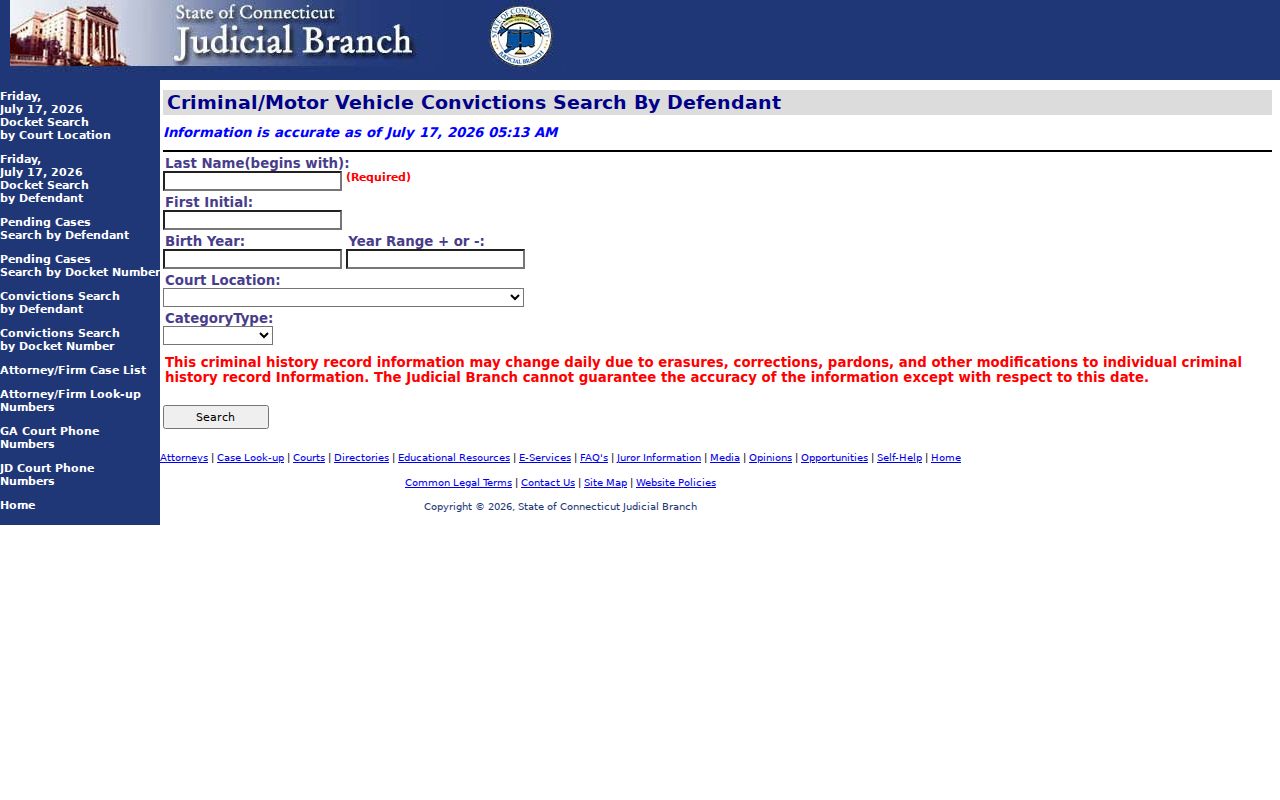
Use that interface to verify outcomes count by count. A nolle, dismissal, acquittal, guilty plea, and no-contest plea have different meanings. If a scheduled matter is absent from pending results, check spelling, the daily docket, the disposed portal, and then the clerk. Youth status, timing, statutory erasure, a sealed file, or a different court can also explain an empty result.
What the Case File Shows
A Judicial Branch docket is event-oriented. It connects the formal charge to the court that hears it, shows scheduled events, and records the result of each public count. Not every document listed on a docket can be downloaded. The clerk remains the authoritative source for a permitted file copy and certification.
| Docket number and court | The unique court identifier, case caption, Hartford location, and GA or Judicial District assignment. |
|---|---|
| Charging information | Each public count, statute citation, charge description, and offense class when displayed. |
| Status and events | Pending or disposed status, hearing dates, event type, and the next appearance for an active matter. |
| Plea and disposition | The plea and outcome for each count, including nolle, dismissal, acquittal, guilty, or nolo contendere. |
| Counsel and bond | Public attorney appearances and bond or release details when the interface includes them. |
| Sentence | Disposition date, sentence, probation, restitution, or other public conditions entered by the court. |
Full dates of birth, Social Security numbers, protected victim or minor identifiers, and erased or sealed material do not belong in the public view. A name match is not proof of identity. Compare the docket's public identifiers and confirm the file through the clerk when accuracy matters.
East Hartford Daily Court Schedule
The Judicial Branch Daily Docket answers a narrower question than a full case search: what is listed for court on a selected day. It can help confirm the next appearance for an East Hartford matter, but it is not the full case file and does not replace the pending or disposed searches.
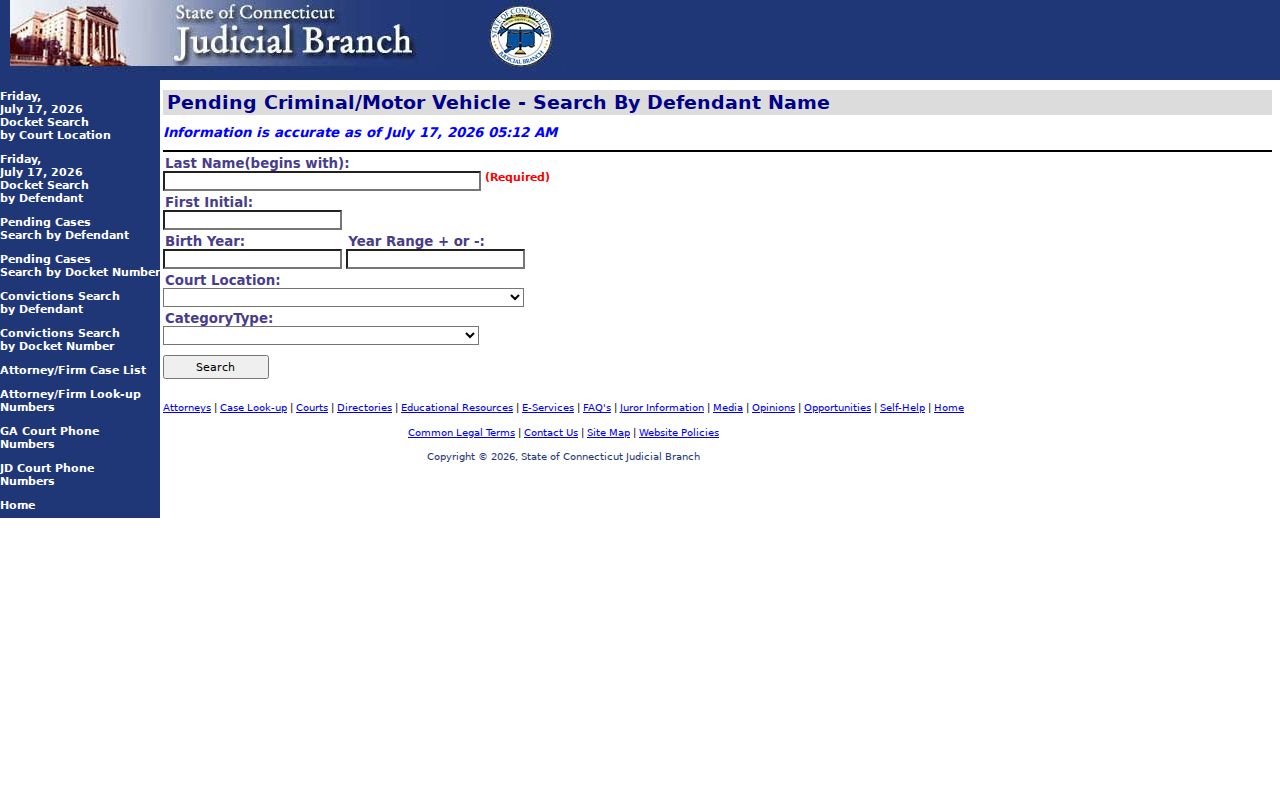
The schedule image illustrates the court-and-date search layer. A date listing may change as the clerk updates calendars, and an appearance can be continued. Match its docket number back to the case detail, then ask the clerk when a calendar entry and the public case view do not agree. A daily listing is useful for timing. It does not prove the final outcome.
Stages of a Criminal Case
A police arrest does not by itself create a conviction. The prosecutor reviews the matter, and the court records formal charges and each later event. At arraignment, the charges are presented and release conditions may be addressed. Pretrial work can include motions, disclosure, negotiations, diversion review, and scheduled hearings. A case may end through dismissal, a prosecutor's nolle, a plea, or a trial result. Sentencing follows a conviction.
Case flow: Charges Filed › Arraignment › Pretrial › Plea or Trial › Disposition › Sentencing
Read each charge on its own line. One count may be dismissed while another produces a plea. A nolle prosequi means the prosecutor declines to continue that charge at that time; it is not a conviction. Nolo contendere means no contest and is treated as a conviction without the same admission as a guilty plea. Probation is court-ordered community supervision administered through the Judicial Branch.
Reading East Hartford Case Outcomes
Short docket terms carry large differences. Treating every closed charge as a conviction gives a false picture of the East Hartford court record. The disposition field for each count is more useful than the fact that a case once appeared online.
- Nolle prosequi
- The prosecutor declines to pursue the charge at that time. Connecticut erasure timing rules can later affect public access.
- Dismissal
- The charge ends without a conviction. Statutory erasure generally follows after applicable appeal rules are satisfied.
- Acquittal
- A not-guilty judgment. It is not a conviction and is subject to Connecticut erasure law.
- Conviction
- A guilty or nolo plea, or a guilty finding, followed by judgment.
- Capias
- A court order directing custody, often tied to failure to appear or comply. Ask the court or counsel about an order involving you.
The Judicial Branch criminal-process information offers official context for court events. It is safer to ask the clerk about an unfamiliar entry than to infer its meaning from a brief code.
East Hartford Court Roles Explained
The Hartford State's Attorney represents the state in prosecutions. Inspectors, victim-service staff, and specialized units may support that office. The clerk is neutral and keeps the docket; clerk staff can explain access and copy procedures but cannot give legal advice. The Division of Public Defender Services provides court-appointed defense to financially eligible defendants after eligibility and appointment through the court process.
The public-defender image connects East Hartford cases to Connecticut's state defense system. It does not identify counsel for a particular docket. Public attorney appearance fields, when shown, should be checked against the current case record because representation can change. For a case involving you, direct legal questions to your lawyer rather than asking records staff to interpret strategy.
Note: Prosecutor, clerk, and defense offices serve different functions even when their contacts appear together in the Hartford court directory.
Access & Restrictions
Connecticut presumes access to many public records, but court files follow Judicial Branch access and sealing rules rather than a town records request. The Connecticut Freedom of Information Act governs many agency records, while the court controls its own files and copy process. The Judicial Branch provides court-record access and copy guidance for people who need documents beyond the online docket.
Juvenile matters, sealed files, protected victim data, full personal identifiers, and erased charges are restricted. Under CGS §54-142a and related criminal-record laws, dismissals and acquittals receive erasure treatment after the applicable final steps. A nolle may become eligible after the statutory period if it is not reopened. Clean Slate also provides automatic erasure for qualifying matters under its own conditions.
When an East Hartford court case does not appear, do not assume that no event occurred. Check both status portals and the daily docket. Then contact the Hartford criminal clerk about an archived public file, unclear status, or certified copy. For broader local records, the East Hartford criminal-history overview separates police, court, state history, and custody sources.